
Something’s Better Than Nothing
TLDR: AI took your job

Each week I want to write about markets, and then Trump does something insane. Something so insane that by the time I hit send whatever I wrote feels “stale.” Of course, this is by design. The shit-flooding of the zone is an intentional weapon of distraction. Most understand this. Less understood, however, is its effect on our ability to actually think. To learn about an issue, to examine it from all sides, and to reach a conclusion. The longer you take to understand one issue (say, invading a NATO ally), the further behind you are on the next issue, i.e. what to do when America starts arresting journalists.
The implication is that no one has time to think critically about anything anymore. Not least the issues that actually matter. We’ve been reduced to reactionaries. If you don’t believe me, watch any news show.
Today, however, I invite you to think critically with me about an issue that does matter. Specifically: What AI will (or won’t) do to jobs in America. If this sounds “boring” to you, resist that feeling. That’s Trump desensitizing your brain from matters of import. As we shall discuss, the AI-jobs debate is profoundly significant, and our nation’s misunderstanding of it, even more so.
They Took Our Jobs
Buried among last week’s disturbing headlines were five major layoff announcements. UPS decided to lay off 30,000 people. Amazon decided to lay off 16,000. Dow Chemical, 4,500. Pinterest, nearly 1,000. OpenAI said they’re “dramatically slowing” hiring.
The critical question: Was it because of AI? In the days following, we started to get answers. Dow Chemical: Yes. Pinterest: Yes. OpenAI: Yes. Amazon: Basically, yes. Perhaps your conclusion is that you don’t believe them. Perhaps you think they’re just saying it’s AI because they think shareholders will like that story. And yet the fact remains: Tens of thousands of people were laid off, and AI was the excuse.
The next critical question: Is this a broader trend? Answer: Yes. A recent report found AI was responsible for 5% of layoffs last year. If that doesn’t sound significant to you, consider the fact that more than 1.2 million job cuts were announced last year, the highest number since the pandemic. Consider also that we’re only a couple of years into AI.
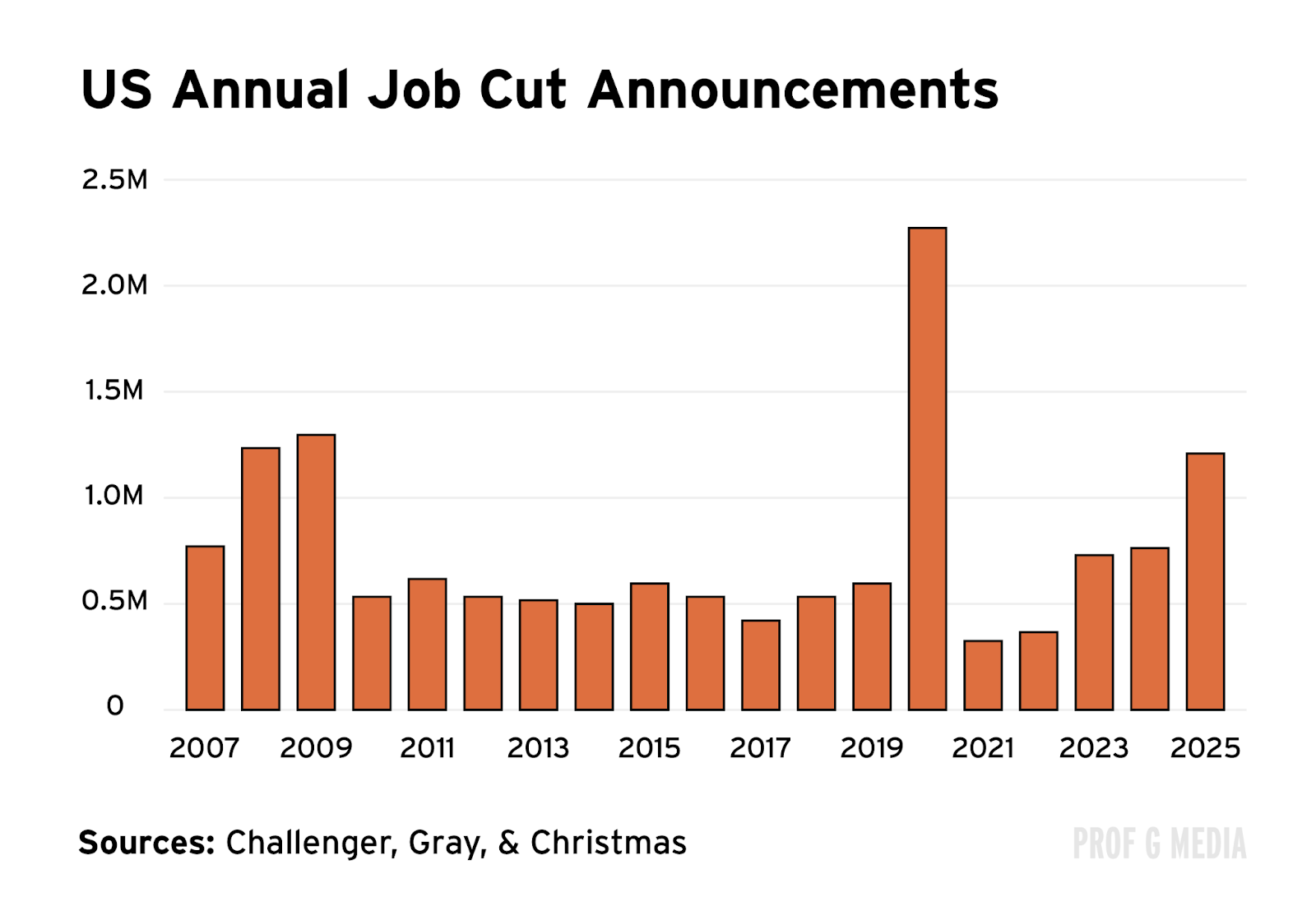
Next critical question: Should we expect this to continue? Answer: Yes. The canary in the coalmine is the entry-level job market, our best indication of what the future job market might look like. Right now, it’s getting rocked. Entry-level job postings have fallen 35% in the past two years. In the highly AI-enabled tech industry, postings have fallen 67%. More than two-thirds of enterprises say they’re slowing entry-level hiring. We recently asked the CEO of Goldman Sachs what his plans for headcount are. His answer: Keep it flat.
Some have pointed to the non-AI reasons for the jobs slowdown: global uncertainty, tariffs, post-pandemic pullback — all valid. But there’s one statement that’s gotten very popular lately, and which is categorically false: That AI isn’t taking jobs. The data is clear: It is. Not all jobs, but many of them. And if we’re being realistic, it’s just getting started.
What To Do?
Let’s assume with 15% probability that AI will eliminate millions of jobs. (I think that’s low but let’s be conservative.) Let’s assume we’re witnessing the arrival of the greatest labor market disruption of the 21st century. What do we do?
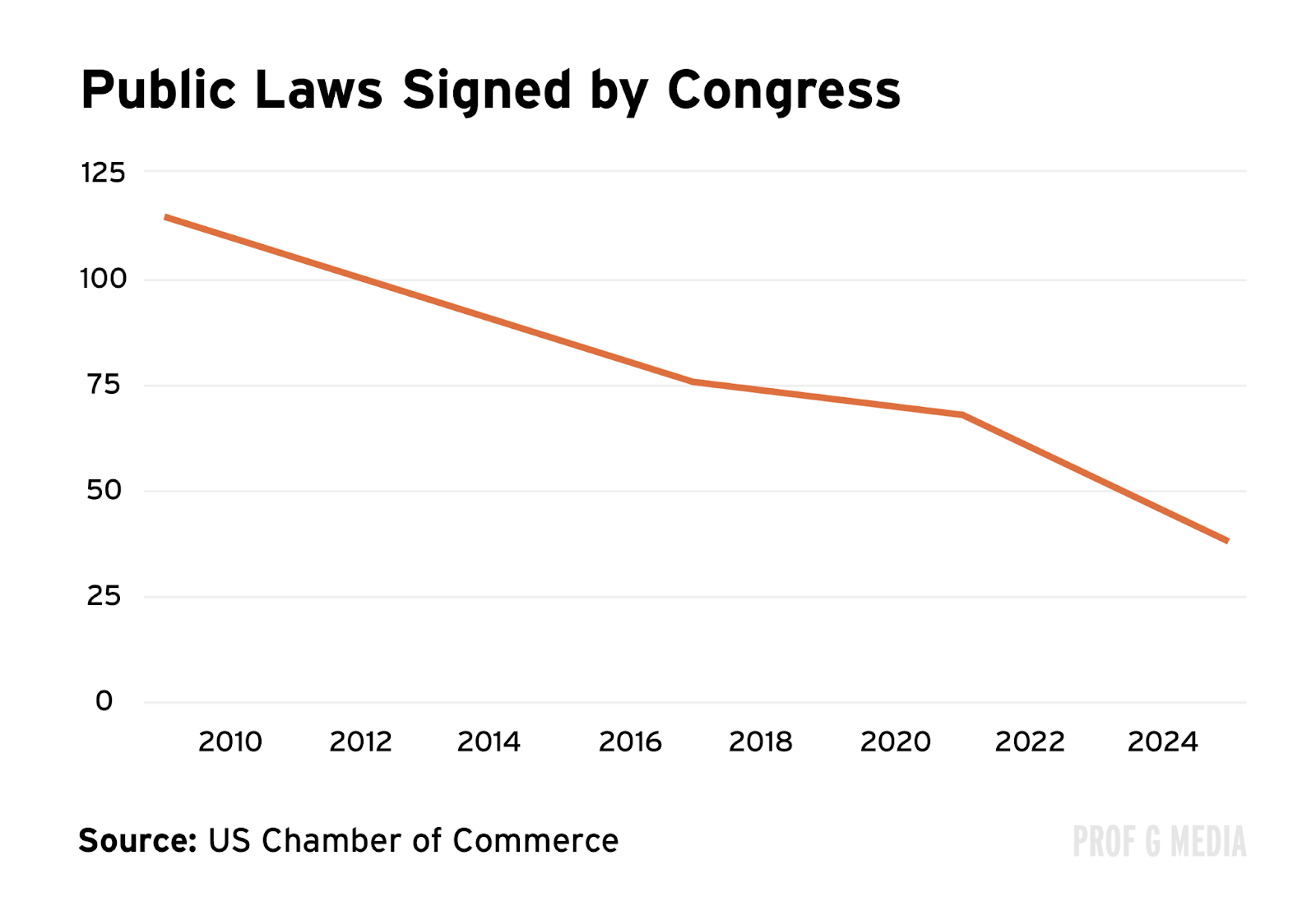
History is helpful, as we’ve dealt with this kind of thing before. During the Industrial Revolution, for example, we responded with child labor laws. When factories reshaped the labor market, we got the Fair Labor Standards Act — establishing the minimum wage. During the Great Depression, we created Social Security. After WWII, we passed the GI Bill. In each of these cases, the playbook was simple: Minimize economic damage with federal policy. Or in plainer English: Write laws.
Fast-forward to 2026. We face yet another critical economic juncture. This time, a technology with the power to transform our very existence. Heads turn to Washington: What do we do? Lawmakers assemble. A taskforce is established. A czar, hired. And finally, the grand strategy is revealed:
Do nothing.
Sit On Your Hands
I am not kidding. The Trump administration’s current AI policy is to do nothing. Not in a “sit back and let things run their course” kind of way, but in a “strap ourselves to the chair and tie our hands behind our backs” kind of way. The most significant AI proposal from the White House was a 10-year moratorium on state-level AI legislation, which prohibited states from writing any laws as they pertain to AI. In addition, the “AI Task Force” turned out to be an “AI Litigation Task Force,” whose job was to hunt down state-level AI proposals and terminate them. The legal standings of these orders aren’t yet clear, but the implications are tremendous.
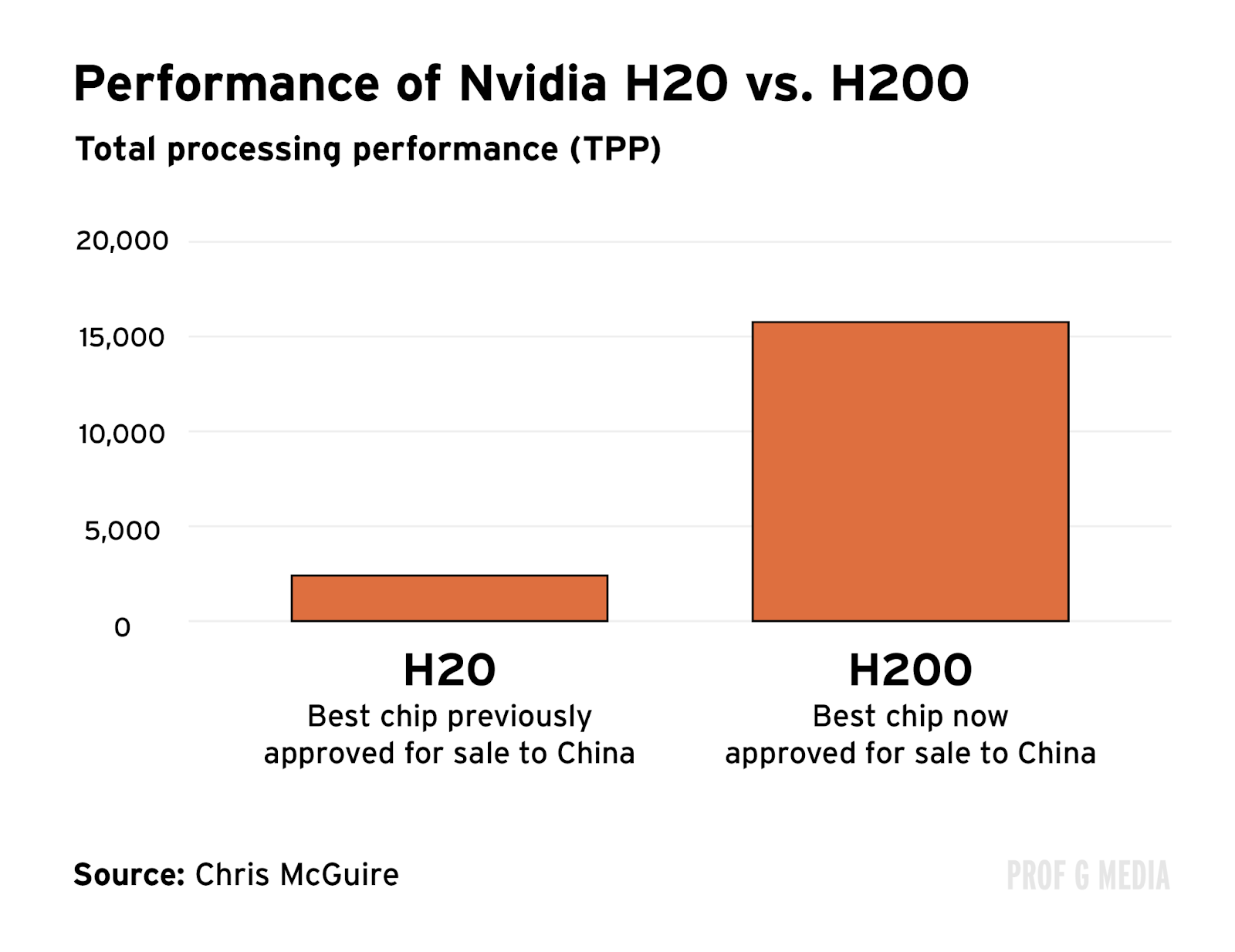
The one subject for which the administration has developed an AI policy is the U.S.-China rivalry. Trump’s initial position was to restrict chip exports to China, and later, to ban them entirely. His view was that we shouldn’t arm the enemy. However he later reversed that position, then reversed it again, and reversed it again, to the point that it’s no longer clear what our position on China actually is. The latest news is that China bought $10 billion worth of Nvidia H200s, a chip six times more powerful than the H20 chip, which was specifically designed to be sold to China. We may have previously had an AI China policy, but it no longer exists.
Our staggering lack of policy has reached a boiling point: CEOs of AI companies are now begging for legislation. Last week, Anthropic CEO Dario Amodei wrote a 38-page essay that repeatedly called on government to do something — anything — about AI. Before that, Google CEO Sundar Pichai was forced to state the obvious: that AI is “too important not to regulate.” Even Elon is supporting AI laws.
The Libertarian Mind Virus
We find ourselves in a unique situation: The people we elected to write laws have decided they don’t want to. Not because they’re lazy (I hope), but because they believe laws are bad. Per AI & Crypto Czar David Sacks, regulation will end up “clamping down on innovation.” We all know where he’s coming from: Too much bureaucracy is bad. But it appears this argument has gotten so far out of whack that our lawmakers now actually believe that no policy is better than a policy.
I have no term for this other than the “Libertarian Mind Virus.” (If you have a better one let me know.) It is the low-IQ, simple-minded, Ayn-Randian belief that regulation and government are our biggest problems. It has manifested in various stupid iterations — from DOGE to ACA cuts to a historically unproductive government. But it appears that it may now actually be our undoing. It may actually be the reason we let AI ruin us.
Something > Nothing
It goes without saying: The solution to our AI problem isn’t to do nothing. I propose a different solution: that we do (wait for it) … something. That doesn’t mean “putting all AI on hold,” as was proposed a couple of years ago. It simply means writing policies that make the AI transition as minimally damaging to people’s lives as possible. Or, at least, trying.
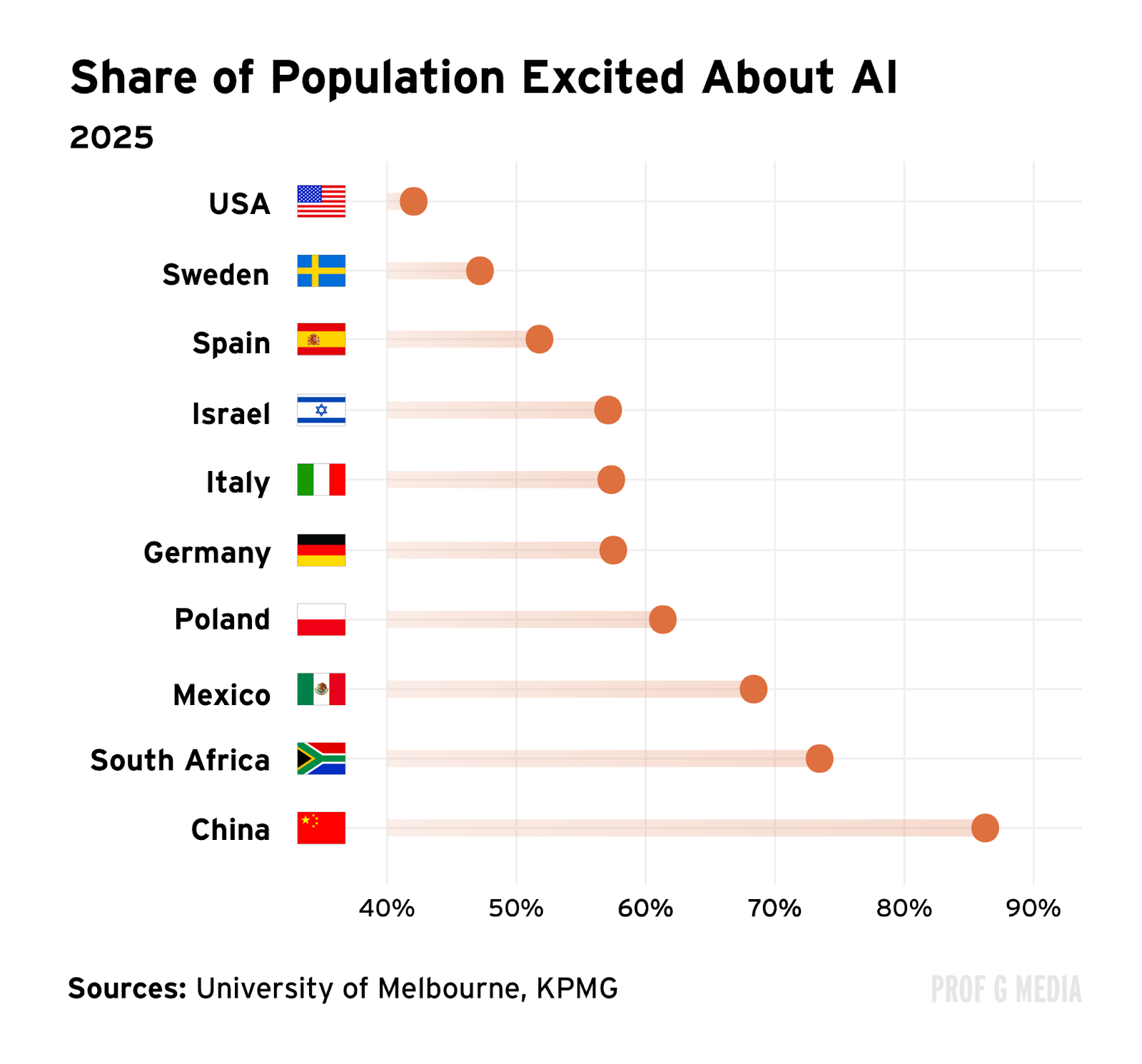
Other countries are doing this — most notably, China. China has some of the most thorough and comprehensive AI legislation in the world. It’s no coincidence that their citizens are dramatically more excited (and less nervous) about AI than Americans are. They know their leaders are doing something about it.
There are plenty of policies we could experiment with. We could create a workforce reinvestment fund that would help retrain displaced employees. Brookings has suggested a residency model to upskill entry-level workers in new domains. Stanford researchers have debated expanding and improving unemployment insurance. We might even consider Universal Basic Income again. After all, what’s happening right now is precisely what Andrew Yang warned us about.
The greatest no-brainer of all, however, was proposed last week by Dario Amodei. He pointed out that, at the very least, our government must start measuring the true labor market impact of AI. The BLS collects some data, but not nearly enough. That is why we’re forced to look to third parties. It’s also why the jobs debate is so misguided — no one really knows WTF is going on because we don’t have the data.
I should hope what I’m proposing is not controversial. That instead of doing nothing, we do something, anything. It could be that all our hard work and preparation was for nought. It could be that AI was a lot less disruptive than we thought. But what’s the harm in prepping? A plan is better than no plan.
Sin City
I’m currently on a flight to Las Vegas to give a keynote. It’s an executive retreat for a large financial institution, which means there will be a lot of very smart people in the room. Naturally, self-doubt is creeping in. What can I offer that will be valuable to them? What can I say that they don’t already know? I’m scouring through my notes, searching for insight. Maybe I have none?
Then I turn back to the (lack of) policy that inspired this post, and am comforted. At the very least, I’ll give them something.
Until next week,
Ed
Ed, just returned from China and Vietnam and their embrace of the future and where they are headed is sadly eons ahead of the US. Pick a topic, healthcare - it is not what people think, embrace of AI, influx of well trained foreign doctors, making it a human right not a profit center unlike the US is mind boggling; electrification of public transit and adoption of EVs, very impressive. Banning social media and crypto, focusing inward on their own brands, culture, ideologies and expanding their exports to new records without the US is remarkable.
Despite anti-regulation sentiment in business and some of society, most of the things people value and benefit from in daily life exist because of regulation.
Safe food and medicine - The FDA approval process emerged after tragedies like the 1937 sulfanilamide disaster (107 deaths from untested medicine) and thalidomide birth defects. Before the Pure Food and Drug Act, products contained many undisclosed dangerous toxins.
Breathable air in cities - The Clean Air Act transformed American cities. Los Angeles in the 1970s had air so toxic that children couldn't play outside on bad days. Lead from gasoline damaged children's cognitive development nationwide. These regulations removed lead from gas, reduced smog, and prevents an estimated 200,000 early deaths annually.
Safe vehicles - Seatbelts, airbags, crumple zones, licensing, road designs and more weren't standard features automakers voluntarily added. Traffic fatalities per mile driven have dropped about 80% since the 1960s. The same applies to aircraft safety safety.
Financial system stability - Banking regulations like deposit insurance (FDIC) mean you don't lose your savings when a bank fails, unlike the thousands who did in the 1930s.
Workplace safety - OSHA reduced workplace fatality rates by roughly 65% since 1970.
Environmental protection - Rivers literally caught fire before the Clean Water Act.
**AI/DATA/CYBER - Opinion: NEW REGULATIONS ARE NEEDED FOR THESE NEW RISKS.
Yes regulations can become outdated and unnecessarily complex and we should seek to incrementally improve these. Overall regulations are a good thing, important and inevitable... it's just a matter of how much injury we as a society are willing to accept before eventually getting started.